Skip to content

+330535385257

{:gb}European Institute of Planted Forest – IEFC{:}{:fr}Institut Européen de la Forêt Cultivée – IEFC{:}{:es}Instituto Europeo Del Bosque Cultivado – IEFC{:}{:pt}Instituto Europeu De Floresta Plantada – IEFC{:}

{:gb}European Institute of Planted Forest – IEFC{:}{:fr}Institut Européen de la Forêt Cultivée – IEFC{:}{:es}Instituto Europeo Del Bosque Cultivado – IEFC{:}{:pt}Instituto Europeu De Floresta Plantada – IEFC{:}

{:gb}The multi-actor network for sustainable management and resilience of planted forests{:}{:fr}Le réseau multi-acteur pour la gestion durable et la résilience des forêts cultivées{:}{:es}La red para la gestión sostenible y la resiliencia de los bosques cultivados {:}{:pt}A rede IEFC para a gestão sustentável e resiliência das florestas cultivadas{:}

  • Homepage
  • Accueil
  • Página inicial
  • Página de inicio
  • About us
    • History
    • Histoire
    • História
    • Historia
    • Mission
    • Mission
    • Missão
    • Misión
    • Team
    • Équipe
    • Equipa
    • Equipo
    • Governance
      • Status and Governance
      • Statut et Gouvernance
      • Status e Governança
      • Estatus y gobernanza
      • General Meetings
      • Assemblées Générales
      • Assembleias Gerais
      • Asambleas Generales
    • Gouvernance
    • Governança
    • Gobernanza
    • Career Opportunities
    • Opportunités de carrière
    • Oportunidades de carreira
    • Oportunidades profesionales
    • Support IEFC – Make a donation
    • Soutenir l’IEFC
    • Apoie a IEFC
    • Apoye a IEFC
  • À Propos
  • Sobre nós
  • Quiénes somos
  • Our members
    • List of Members
    • Liste Des Membres
    • Lista de Membros
    • Lista de Miembros
    • Login IEFC Members
    • Connexion Membres IEFC
    • Faça login Membros da IEFC
    • Iniciar sesión Miembros de IEFC
    • Become a Member
    • Devenir membre
    • Torne-se Membro
    • Hazte Miembro
  • Nos Membres
  • Os Nossos Membros
  • Nuestros Miembros
  • Infrastructures
    • Network of Plots
    • Réseaux de Parcelles
    • Rede de Parcelas
    • Red de Parcelas
    • Digital Infrastructures
      • Silvalert
      • Formodels
      • Tree Data
    • Infrastructures Numériques
    • Infraestruturas Digitais
    • Infraestructuras Digitales
    • Living Labs
    • Laboratoires Vivants
    • Laboratórios Vivos
    • Laboratorios Vivientes
  • Infrastructures
  • Infraestruturas
  • Infraestructuras
  • Networking
    • Webinars
      • Webinars IEFC
        • AppPopuli+ and Silvalert
        • Maritime pine and Pine Wood Nematode
        • Douglas Fir health: insights from Europe
        • Webinars Replays – Let’s Talk About Planted Forests
      • Webinaires IEFC
      • Webinar on European Projects
        • FIRE-RES – Innovation Actions
      • Webinaire sur les Projets Européens
    • Webinaires
    • IEFC General Assembly – 2026
      • Registration
      • Tentative Agenda
      • Practical Information
    • Next Events
    • Évènements À Venir
    • Próximos Eventos
    • Próximos Eventos
    • IPC 27th Session
    • IEFC – Network Fund 2026
  • Réseautage
  • Rede de contactos
  • Redes
  • Projects
    • IEFC Projects
    • Projets IEFC
    • Projetos IEFC
    • Proyectos IEFC
    • Pasts Projects
      • DEFOR
      • DEFOR
      • DEFOR
      • DEFOR
      • FORSEE
      • FORSEE
      • FORSEE
      • FORSEE
      • IMACFORD
      • IMACFORD
      • IMACFORD
      • IMACFORD
      • EUROSILVASUR
      • EUROSILVASUR
      • EUROSILVASUR
      • EUROSILVASUR
      • FORRISK
      • FORRISK
      • FORRISK
      • FORRISK
      • PLURIFOR
      • PLURIFOR
      • PLURIFOR
      • PLURIFOR
      • Others
      • Autres
      • Outros
      • Otros
    • Projets Anciens
    • Projetos Anteriores
    • Proyectos Anteriores
  • Projets
  • Projetos
  • Proyectos
  • Media Library
    • Communication
      • Logo & Graphic Charter
      • Logo & Charte Graphique
      • Logótipo e Carta Gráfica
      • Logotipo y carta gráfica
      • IEFC Press
        • Press Kit
        • Dossier De Presse
        • Kit de Imprensa
        • Dossier de Prensa
        • Press Review about IEFC
        • La Presse Parle de l’IEFC
        • Revista de imprensa sobre a IEFC
        • Revista de prensa sobre IEFC
        • Press Releases
        • Communiqués de Presse
        • Comunicados de Imprensa
        • Comunicados de Prensa
        • Media Toolkits
        • Kit De Communication
        • Kits de ferramentas de Mídia
        • Kits Mediáticos
      • Presse IEFC
      • Imprensa da IEFC
      • Prensa IEFC
      • IEFC Newsletters
        • Subscribe To IEFC Newsletter
        • S’abonner À Notre Newsletter
        • Subscreva a Boletim do IEFC
        • Suscríbete al Boletín de IEFC
        • Our Latest Newsletters
        • Nos Dernières Newsletters
        • Nossas últimas Boletins
        • Nuestros últimos Boletines
      • Newsletters IEFC
      • Boletim do IEFC
      • Boletín del IEFC
    • Communication
    • Comunicação
    • Comunicación
    • IEFC Library
    • Bibliothèque IEFC
    • Biblioteca IEFC
    • Biblioteca IEFC
    • Resource Centre
    • Centre de Ressources
    • Centro de Recursos
    • Centro de Recursos
    • Educationnal Materials
    • Ressources Pédagogiques
    • Materiais Educativos
    • Materiales Educativos
    • IEFC Publications
    • Publications IEFC
    • Publicações do IEFC
    • Publicaciones del IEFC
    • Presentations And Papers
    • Présentations Et Articles
    • Apresentações e Artigos
    • Presentaciones y Artículos
  • Médiathèque
  • Biblioteca Multimédia
  • Biblioteca Multimedia
xClose Menu
Home/{:fr}Archives{:}, {:fr}Bioeconomie{:}{:es}Bioeconomia{:}{:pt}Bioeconomia{:}{:gb}Bioeconomy{:}, IEFC Newsletter, Non Wood products/Pine oleoresin market in the context of a health crisis

Pine oleoresin market in the context of a health crisis

21 December 2020 comm IEFC 0 Comments 0 tags
Home/{:fr}Archives{:}, {:fr}Bioeconomie{:}{:es}Bioeconomia{:}{:pt}Bioeconomia{:}{:gb}Bioeconomy{:}, IEFC Newsletter, Non Wood products/Marché de la gemme de pin en contexte de crise sanitaire

Marché de la gemme de pin en contexte de crise sanitaire

21 December 2020 comm IEFC 0 Comments 0 tags
Home/{:fr}Archives{:}, {:fr}Bioeconomie{:}{:es}Bioeconomia{:}{:pt}Bioeconomia{:}{:gb}Bioeconomy{:}, IEFC Newsletter, Non Wood products/Mercado de la oleorresina de pino en un contexto de crisis sanitaria

Mercado de la oleorresina de pino en un contexto de crisis sanitaria

21 December 2020 comm IEFC 0 Comments 0 tags

International trade data for oleoresin and the primary processing products rosin and turpentine are not always made transparent by the customs services of the different countries. Therefore, one of the objectives of the SustForest+ project is to offer a view on the evolution of the international market to European stakeholders of the pine oleoresin sector.

The COVID-19 pandemic had an impact on economies around the world and the resin market was not exempt. During the 2nd quarter of 2020, the GDP of most Western countries decreased while the one in China increased by 11.50%. While the volumes of resin and rosin exported to Europe decreased, exports to Asia increased significantly. Between the second quarter of 2020 and the second quarter of 2019, rosin exports from Brazil to China almost doubled.

This spectacular growth in the context of a health crisis is part of a deeper evolution of the Chinese economy. Over the last 20 years, the country has continuously reduced its production and participation as a global supplier of rosin and turpentine made from oleoresin. This decline is linked to the low productivity of the tapping systems used and the rapid increase in wages in China. Nevertheless, China has increased the share of processing of these raw materials internally, becoming an exporter of higher value-added processed products.

Meanwhile, Brazil has doubled its oleoresin production in the last 6 years thanks to the use of efficient techniques, genetic selection of pine trees for their resin productivity and the availability of cheap labour. The country has thus become the world’s leading exporter of oleoresin, rosin and turpentine.
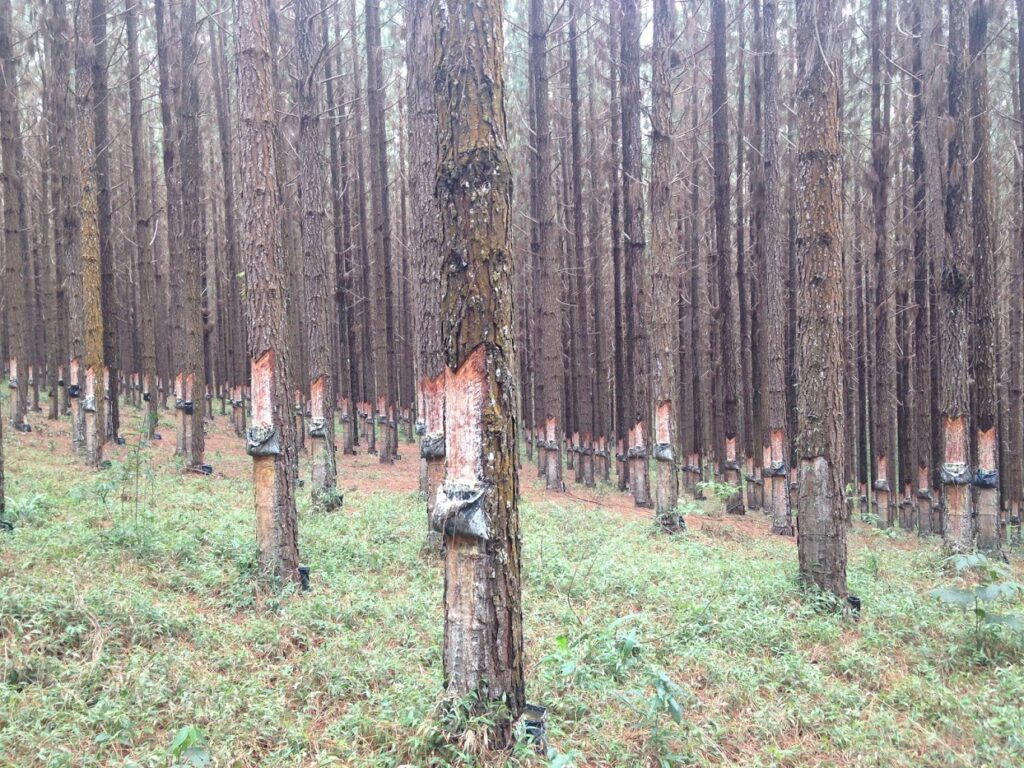
Genetically improved pine forest in Brazil

Europe has benefited from a rise in the price of resin over the last decade to increase its production, which was almost stopped, mainly in Spain and Portugal. At the same time, tapping activity restarted in France thanks to mechanisation with a strong value in niche markets. Production levels in Europe are still very low in comparison with world production and the activity remains subject to international competition. However, the growing demand for renewable and sustainable products from developed countries is likely to favour this market of low-carbon products in the future.

It seems that China’s growing demand for gum rosin and turpentine will not be offset by the growth of this sector in Brazil. Low stocks of rosin worldwide could lead to higher prices. At the same time, paper mill activity has decreased in Europe and the United States, leading to a reduction in the distillation of Tall oil (resin obtained as a by-product in paper production). As a result, the production of Tall oil rosin, a possible substitute for gum rosin, has decreased. Despite all these factors that are favourable to increased tapping, the sector will continue to be affected by competition from hydrocarbon resins, towards which China could move more in the future, depending on the evolution of the price of oil.

Author: Armand Clopeau (IEFC)


Link to the conjecture note

Post navigation

Previous PostPrevious
Next PostNext

Les données de commerce international de la gemme et des produits de première transformation que sont la colophane et la térébenthine ne sont pas toujours rendues transparentes par les douanes des différents pays. Pour cette raison, l’un des objectifs du projet SustForest+ est d’offrir une vue sur l’évolution du marché international aux acteurs européens du secteur de la résine issue du gemmage des pins.

La pandémie de COVID-19 a eu un impact sur les économies du monde entier et le marché de la résine n’a pas été épargné. Au cours du 2ème trimestre 2020, le PIB de la plupart des pays occidentaux a diminué tandis que celui de la chine a augmenté de 11,50% sur cette période. Tandis que les volumes de résine et de colophane exportés vers l’Europe ont diminué, les exportations vers l’Asie ont largement augmenté. Entre le second trimestre 2020 et le second trimestre 2019, les exportations de colophane du Brésil vers la Chine ont pratiquement doublé.

Cette croissance spectaculaire en contexte de crise sanitaire s’inscrit dans une évolution plus profonde de l’économie chinoise. Au cours des 20 dernières années, le pays a continuellement réduit sa production et sa participation en tant que fournisseur mondial de colophane et de térébenthine de gemme. Ce déclin est lié à la faible productivité des systèmes de gemmage utilisés et à l’augmentation rapide des salaires en Chine. Malgré cela, la Chine a augmenté la part de transformation de ces matières premières en internes, devenant un exportateur de produits transformés à plus forte valeur ajoutée.

Pendant ce temps, le Brésil a doublé sa production de gemme au cours des 6 dernières années grâce à l’emploi de techniques efficaces, la sélection génétique de pins pour leur productivité en gemme et la disponibilité d’une main d’œuvre bon marché. Ce pays est ainsi devenu le premier exportateur mondial de résine, de colophane et de térébenthine issus du gemmage.

Forêt de pins génétiquement améliorés en gemmage au Brésil

L’Europe a bénéficié d’une hausse du prix de la résine au cours de la dernière décennie pour augmenter sa production qui était quasiment à l’arrêt, essentiellement en Espagne et au Portugal. Parallèlement, le gemmage s’est développé en France grâce à la mécanisation de l’activité et la forte valorisation sur des marchés de niche. Les niveaux de production de l’Europe demeurent très faibles en comparaison avec la production mondiale et l’activité reste soumise à la concurrence internationale. Toutefois, la demande croissante en produits renouvelables et durables des pays développés sera susceptible de favoriser à l’avenir ce marché de produits à faibles emprunte carbone.

Il semble que les besoins croissants de la Chine en colophane de gemme ne pourront pas uniquement être compensés par la croissance de ce secteur d’activité au Brésil. De faibles stocks de colophane dans le monde pourraient entraîner une hausse des prix. Dans le même temps, l’activité des papeteries a diminué en Europe et aux Etats-Unis, entrainant une réduction de la distillation du Tall oil (résine obtenue comme sous-produit lors de la production du papier). La production de colophane de Tall oil, substitut possible de la colophane de gemme, a donc baissé. Malgré ces facteurs favorables au gemmage, le secteur continuera de ressentir la concurrence des résines d’hydrocarbures vers lesquelles la Chine pourrait davantage s’orienter à l’avenir, selon l’évolution du prix du pétrole.

Auteur : Armand Clopeau (IEFC)


Lien vers la note de conjecture

Post navigation

Previous PostPrevious
Next PostNext

International trade data for oleoresin and the primary processing products rosin and turpentine are not always made transparent by the customs services of the different countries. Therefore, one of the objectives of the SustForest+ project is to offer a view on the evolution of the international market to European stakeholders of the pine oleoresin sector.

The COVID-19 pandemic had an impact on economies around the world and the resin market was not exempt. During the 2nd quarter of 2020, the GDP of most Western countries decreased while the one in China increased by 11.50%. While the volumes of resin and rosin exported to Europe decreased, exports to Asia increased significantly. Between the second quarter of 2020 and the second quarter of 2019, rosin exports from Brazil to China almost doubled.

This spectacular growth in the context of a health crisis is part of a deeper evolution of the Chinese economy. Over the last 20 years, the country has continuously reduced its production and participation as a global supplier of rosin and turpentine made from oleoresin. This decline is linked to the low productivity of the tapping systems used and the rapid increase in wages in China. Nevertheless, China has increased the share of processing of these raw materials internally, becoming an exporter of higher value-added processed products.

Meanwhile, Brazil has doubled its oleoresin production in the last 6 years thanks to the use of efficient techniques, genetic selection of pine trees for their resin productivity and the availability of cheap labour. The country has thus become the world’s leading exporter of oleoresin, rosin and turpentine.

Genetically improved pine forest in Brazil

Europe has benefited from a rise in the price of resin over the last decade to increase its production, which was almost stopped, mainly in Spain and Portugal. At the same time, tapping activity restarted in France thanks to mechanisation with a strong value in niche markets. Production levels in Europe are still very low in comparison with world production and the activity remains subject to international competition. However, the growing demand for renewable and sustainable products from developed countries is likely to favour this market of low-carbon products in the future.

It seems that China’s growing demand for gum rosin and turpentine will not be offset by the growth of this sector in Brazil. Low stocks of rosin worldwide could lead to higher prices. At the same time, paper mill activity has decreased in Europe and the United States, leading to a reduction in the distillation of Tall oil (resin obtained as a by-product in paper production). As a result, the production of Tall oil rosin, a possible substitute for gum rosin, has decreased. Despite all these factors that are favourable to increased tapping, the sector will continue to be affected by competition from hydrocarbon resins, towards which China could move more in the future, depending on the evolution of the price of oil.

Author: Armand Clopeau (IEFC)


Link to the conjecture note

Post navigation

Previous PostPrevious
Next PostNext

Archieves

  • March 2026
  • January 2026
  • November 2025
  • June 2025
  • May 2025
  • Categories

  • {:fr}Bioeconomie{:}{:es}Bioeconomia{:}{:pt}Bioeconomia{:}{:gb}Bioeconomy{:}
  • {:fr}Climate change{:}
  • {:fr}Membres associés{:}{:es}Socios asociados{:}{:pt}Associados{:}{:gb}Associate members{:}
  • {:fr}Membres{:}{:es}Miembros{:}{:pt}Membros{:}{:gb}Members{:}
  • {:fr}Archives{:}
  • Recent Posts

    • Webinar – Let’s Talk About Planted Forests – 8 April 2026
    • International Day of Forests 2026 – Message from Christophe Orazio, Director of the IEFC
    • Webinar – Let’s Talk About Planted Forests – 27 February 2026
    • Introduction of the pine wood nematode in France: what can research do?
    • Introdução do nemátodo do pinheiro em França: o que pode a investigação fazer?

    Search

    ©IEFC Copyright ©2025 Tous droits réservés